Battery manufacturers don't like to talk about it, but incorrect charging is the main reason batteries retire early or cause fires. In 2025 alone, fires from a single battery model caused more than $734,000 in property damage. These mistakes even turned the batteries of the well-known brand Rad Power Bikes into a fire risk and contributed to its bankruptcy.
Let's look at the 22 most common charging mistakes. We've cleaned these points of internet myths and give you the plain reality of what lithium cells and electronics really need.
1. Not reading the manual for your specific battery
This is the mother of all mistakes, made by as many as 97% of riders. The problem is that different manufacturers use different cell chemistries and differently configured management units (BMS). Your manual contains the exact engineering limits for your particular model. If it says you should charge at a specific temperature, that isn't just a recommendation – it's a physical limit for that chemistry.
2. Charging with the bike's system switched on
Video myths claim that it "confuses" the battery system because energy is flowing both in and out. In reality? A good BMS is designed to handle various situations – charging with the system switched on won't confuse it. The problem lies elsewhere. First, charging itself warms the battery, and an unnecessarily switched-on motor controller adds another source of heat to the system. Heat is the main enemy of lithium cells – every extra degree during charging takes its toll on their capacity over the long term. Second, the motor controller and display have a non-negligible parasitic draw even when "idle". It doesn't directly interfere with charging, but it puts an unnecessary load on the BMS, which has to compensate for this draw while also managing cell balancing. The result is a less efficient balancing process and a higher overall load on the electronics. Simply switch the bike off while charging – it's an easy habit that spares the electronics.
3. Ignoring physical damage, swelling or a smell
If the battery casing is cracked, the battery has suddenly "swollen", or you notice a sweetish chemical smell while charging, disconnect it immediately. The smell doesn't mean liquid is leaking from the battery. It means that the pressure inside a cell has risen, its internal safety vent has physically ruptured and the cell has opened (so-called venting). The electrolyte escapes in the form of highly flammable gases. A swollen casing is a sign that these gases are building up under the battery's cover. If you keep charging a compromised battery like this, you risk an explosion and thermal runaway. Take it for safe disposal.
4. Charging on flammable surfaces
An e-bike battery has a huge capacity (typically 400 to 800 Wh, compared with 15 Wh in a phone). If you charge it on a sofa or carpet, the soft surface traps heat and prevents cooling. If something goes wrong, these materials also act as fuel for a fire. Always charge on a hard, non-flammable surface.
5. Storing a completely flat battery at zero
If you put the battery away flat for a long time, natural self-discharge can push it below the critical protective threshold. The BMS then locks the battery permanently to prevent an internal short circuit when you try to charge it. Your expensive battery becomes a useless brick. Always charge it to at least half before putting it away.
6. Long-term storage at 100%
If you're putting your e-bike away for the winter, don't charge it fully. At 100% charge, lithium cells degrade fastest because of the high voltage stress. You'll lose 2–4% of capacity per month through pure chemical ageing. Storing it at 40–60% is ideal.
7. Deep discharging (riding until it dies)
What harms modern lithium batteries most are deep cycles – frequently discharging them until the system cuts out for protection. It puts unnecessary stress on the cell chemistry and wears them out much faster than shallow cycles. It's better to charge more often, for example when you have 20 or 30% left. Shallow cycles do the battery nothing but good.
8. MYTH: "Never charge to 100%"
It's true that for everyday riding it's better to charge only to 80%, as this reduces voltage stress. But you MUST regularly (for example every tenth charge, or at least once a month) charge your e-bike battery fully and leave it connected. Only at full charge (in the final phase of charging) can the BMS start so-called cell balancing. It equalises the voltage across all the internal sections of the battery. If you don't do this, the battery will gradually become unbalanced and your range will drop rapidly.
9. Leaving it on the charger after it reaches maximum
A modern, good-quality charger physically cuts the current once it reaches 100%, so it doesn't directly "overcharge" the battery. The problem is that if you leave the battery plugged in for hours or days, you expose it to the stress of being held at maximum voltage (4.2 V per cell) for a long time. Unplug the charger as soon as charging is complete, or use a cheap plug-in timer.
10. Charging in a hot environment (above 29 °C) and the limits of the BMS
Heat kills batteries extremely quickly. You might think the BMS will protect the battery and switch off charging if it overheats. The hardware reality is different: cheaper batteries often have just one temperature sensor stuck somewhere on the edge of the pack. By the time this sensor registers a critical temperature, the cells in the middle are already cooking. Premium batteries measure temperature more accurately, but their limit is often set at an extreme 45–55 °C to prevent fire, not loss of capacity. A huge advantage today is batteries with an integrated "smart BMS", where you can see the battery's current temperature in an app. The ideal temperature for charging is 15–24 °C.
11. Charging in the cold (below 10 °C) – the silent killer
When a battery is charged in the cold, lithium ions can't be properly absorbed into the anode and instead deposit on the surface of the electrodes as metallic lithium (so-called lithium plating), which is irreversible damage. The treacherous thing is that the damage starts at temperatures below 10 °C. In theory the BMS blocks charging, but usually only at extremes close to freezing. In winter, always bring the battery indoors, let it warm up naturally for at least an hour so that the temperature evens out even in the deep layers of the cells, and only then connect the charger.
12. Using cheap no-name chargers
You've lost your €80 original charger, so you order a €25 "universal" one from AliExpress or a dubious online shop. The connector fits, the green light is on, so you feel everything is fine. In fact you've just connected a time bomb to your bike. Here are three technical reasons why:
- Not following the CC/CV algorithm and voltage instability: Charging lithium isn't just about blindly "pushing" current. It requires a strict two-phase algorithm. Cheap chargers commonly have an error tolerance of +/- 5% and deliver extremely unstable voltage. If, instead of a precise 4.2 V per cell, the charger delivers 4.25 V, the cell chemistry immediately starts to degrade irreversibly.
- Dirty current (ripple current): Cheap adapters skimp on filter capacitors. They send current with high ripple into the battery, which stresses the BMS electronics and causes unnecessary heating of the cells even at low currents.
- No communication: Premium chargers communicate with the battery. If the battery reports a problem, the original charger reduces or stops the current. A cheap charger is "deaf and blind". If a transistor in the BMS happens to fail, a cheap charger won't stop pushing current until a fire breaks out. What's more, using a no-name charger automatically voids your warranty.
13. Charging immediately after a ride
After a demanding ride in the hills your battery is warm, possibly even hot to the touch. Your instinct tells you to plug it straight into the charger. That's a fatal mistake. During charging the battery's temperature doesn't fall – on the contrary, it keeps rising. This huge thermal stress destroys the cells irreversibly. Simply wait 30 minutes for the battery to cool naturally to room temperature. But never wrap it in a towel so it can "rest" – insulating it only stops it from cooling.
14. Choosing the wrong place and ignoring your escape route
This is a rule that could save your life. Never charge your bike near exits, in the hallway by the front door or on the only staircase leading out of the house. Why? Because if thermal runaway does happen and the battery catches fire, a lithium battery fire is extremely intense and spreads in a flash. If a burning battery blocks your only exit, you'll be trapped inside. Charge in a well-ventilated space and always make sure that in the event of a fire you have a clear escape route without having to pass right next to the burning battery.
15. Charging at public outdoor stands in summer
On long summer rides it's tempting to top up your e-bike at a mountain hut or restaurant, where public charging stands are increasingly common. The problem is that these bike stands are often in direct sunlight. The battery's black plastic casing absorbs UV radiation and the ambient temperature alone can exceed 30 °C. If you push charging current into a battery this hot, thermal stress attacks it from two sides.
- What to do: If the stand is in the sun, don't leave the bike charging there. The ideal solution is to remove the battery from the frame, take it inside the restaurant with your charger and ask the staff to charge it somewhere shady and cool. If you have to charge outside, always make sure the bike is in deep shade. Warning – never try to create artificial shade for the battery by wrapping it in a jacket or backpack while charging. This completely blocks the heat from charging escaping and the battery will cook in its own juices.
16. The risks of fast charging and maximum currents
Many riders buy "fast chargers" (e.g. 6 A to 8 A) to save time. Here, though, you need to watch out for technical limits:
- Maximum safe current: Most e-bike batteries are built for a charging current of around 0.2C to 0.5C. For a 10 Ah battery that's 2 A to 5 A. If you push 8 A (almost 1C) into it, the cells experience extreme chemical stress.
- Excessive heat: Fast charging dramatically increases the internal resistance and temperature of the cells, which speeds up electrolyte evaporation and separator breakdown.
- Lithium plating: As in the cold, at too high a current lithium ions can't get into the anode fast enough and deposit on it as metal. This permanently reduces battery capacity.
- Shorter lifespan: Regular fast charging can cut your battery's number of cycles by as much as a third. Use a fast charger only occasionally on the road; for everyday charging at home a slow charger (2 A – 4 A) is always better.
17. Forcing the battery to "top up" when it won't charge fully
What does it mean when the charger shows green but the display shows only 85%, or the battery doesn't reach its maximum rated voltage (for example a 48 V battery should be at 54.6 V when fully charged, but stops at 51 V)? It means the battery is seriously unbalanced internally or contains a dead cell. The BMS constantly monitors the voltage of every section inside. If one section is full, the BMS cuts off charging immediately so as not to overcharge that section and cause an explosion.
- The biggest mistake: People then tend to unplug and replug the charger in an attempt to "push" the battery to 100%. All this does is overload and damage the section that is already full.
- What to do: A standard BMS can only balance tiny deviations, as it works with balancing currents of around 30–50 mA. It can't cope with a large imbalance on its own. Don't force the battery. Take it to a service centre for professional diagnostics, where a technician will manually balance or replace the faulty sections.
18. Connecting the cables in the wrong order (sparks and melted connectors)
Most people instinctively do it wrong: they plug the cable into the battery and only then plug the charger into the wall. This is a big mistake.
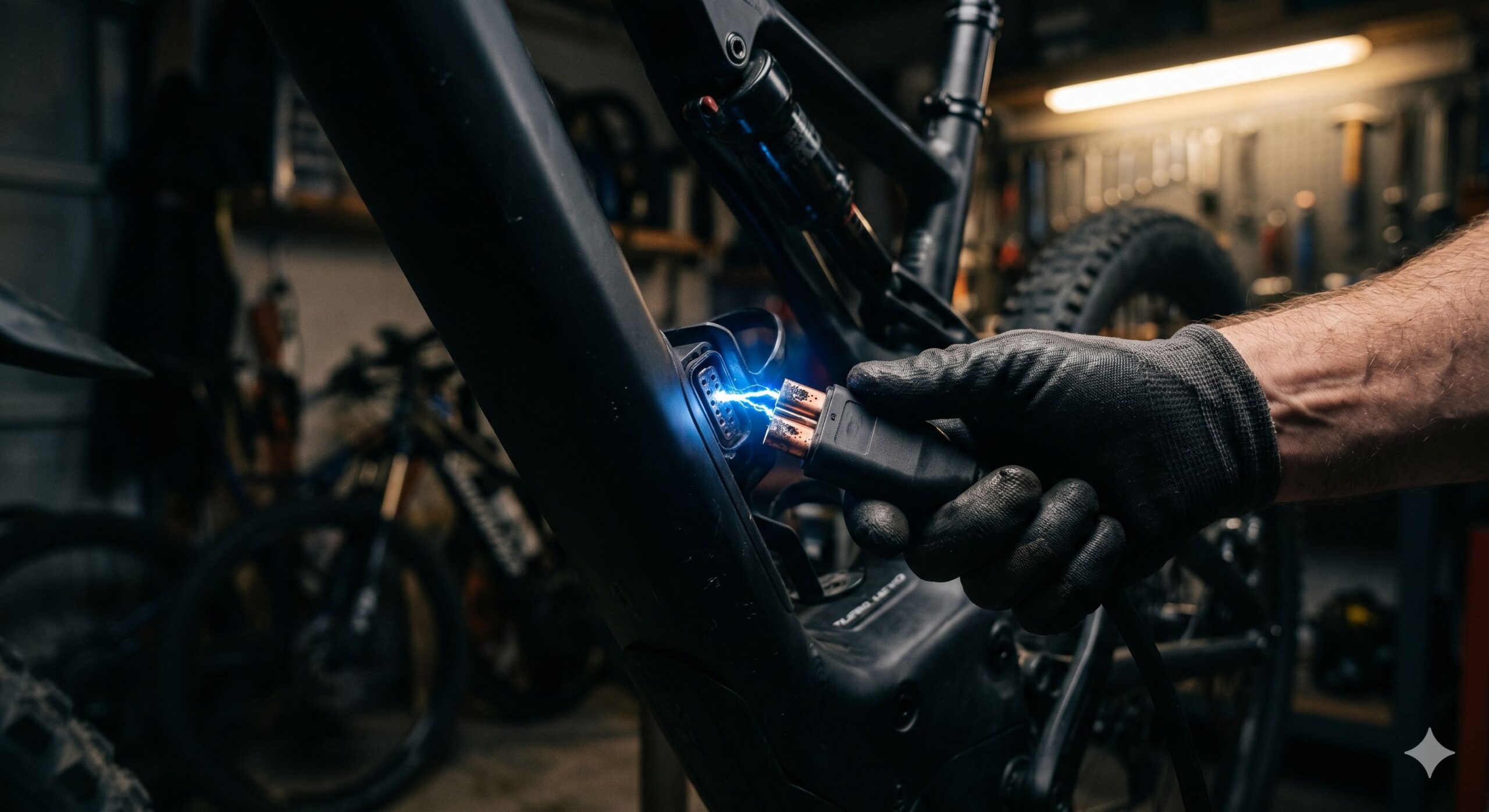
- Why it sparks: If you connect a "dead" (unplugged) charger to a full battery, the empty capacitors inside the charger instantly draw a huge current from the battery to equalise the voltage. The result is a strong blue spark that jumps between the pins just before they physically touch.
- What really happens: Each such spark literally blasts away a microscopic layer of gold or silver on the contacts and leaves a black carbon deposit on them. A smooth metal surface turns into a rough crater. This drastically reduces the physical contact area. When you then try to push charging current (e.g. 4 amps) through this reduced, oxidised, high-resistance point, physics doesn't let go – the lost electrical energy turns into pure heat. The connector starts working like a miniature heater, which eventually melts the plastics and causes a short circuit.
- The right way: First plug the charger into the mains (the wall). Wait a few seconds for its capacitors to charge (usually a green LED lights up). Only then connect it to the e-bike battery. The voltages will already be equalised and no spark will occur. (Note: unless the manual for your premium bike explicitly says otherwise because of its own communication protocol, always follow this physical rule.)
19. Charging a wet battery after riding in the rain (a conductive trap)
Riding in the rain doesn't bother an e-bike, but charging immediately afterwards is a huge risk for the electronics. E-bike batteries are water-resistant (IPX4 or IPX5), not waterproof like a submarine. After a ride, moisture often gets trapped right in the charging port or under its rubber cap.
- What really happens: If you connect the charger to a damp port, the water forms a conductive bridge between the pins. Direct current (DC) then starts a process of electrolysis. If the water is also dirty from the road or contains residues of winter salt, the process speeds up considerably. Electrolysis gradually attacks the surface finish of the pins (which are usually gold- or tin-plated). It won't eat them away in five minutes, but with repeated charging of a damp port the contacts oxidise, turn black and their contact resistance rises dramatically. An even more serious, real risk is that the accumulated water can cause a direct short circuit before the BMS protection board.
- The ultimate practical tip: If you got wet, remove the battery from the frame and wipe it dry. Blow out the charging port thoroughly (with a compressor, a can of compressed air or at least your mouth). Leave the port cap OPEN and let the battery dry at room temperature for at least 2–3 hours. Never use a hairdryer – hot air could push moisture deeper past the seals towards the cells. Only when you're 100% sure the port is completely dry should you connect the charger.
20. Charging through poor-quality extension cords
A very common and dangerous mistake. Cheap extension cords have thin conductors that aren't rated for the sustained charging current of an e-bike. This causes the cable to overheat and creates a real fire risk. The risk is even higher if you leave the cable coiled on a reel – it then acts like a coil and heats up even more. The charger should always be plugged directly into the wall or into a good-quality extension cord with a sufficient conductor cross-section (at least 1.5 mm²).
21. Leaving the battery in a hot car
People often remove the battery after a ride and leave it in a parked car. The temperature inside a car in direct sunlight can reach 60–80 °C in summer. For lithium chemistry this is a disaster, leading to immediate cell degradation and a huge risk of thermal runaway. Never leave the battery in the car as if in an oven, even when it isn't charging.
22. Ignoring a damaged or breaking charging cable
Frequent use creates cracks in the cable insulation, especially where it enters the connector. People ignore these "breaks" or just tape over them with insulating tape. But it's a direct short-circuit and fire risk. If the insulation is damaged or the wires inside are broken, the cable heats up extremely at the point of damage. Replace such a charger immediately or have it professionally repaired.
Conclusion
The life of your battery and the safety of your home depend on your habits. Remember to unplug the battery, don't charge it in extreme conditions, connect the cables in the right order, keep it dry and use only good-quality electrical installations. Both your wallet and your safety will thank you.