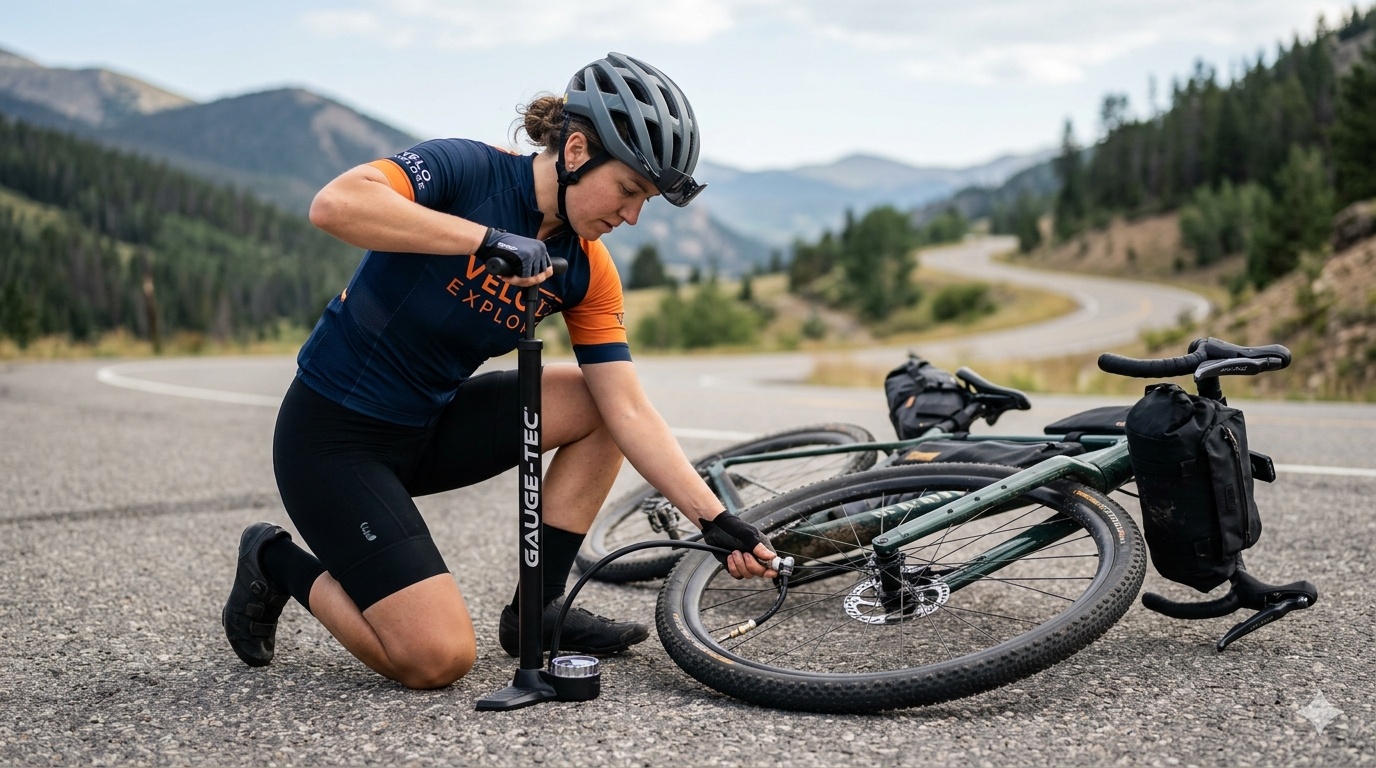
Tyre pressure is the cheapest and quickest "upgrade" for your bike – and most people get it wrong. Too high a pressure pounds your spine, too low damages the rim and increases the risk of a puncture. We'll show you how to find the right pressure for your weight, tyre width and surface.
Why pressure matters so much
The tyre is the bike's only contact with the ground. Its pressure determines how the bike rides, how comfortably you sit, how much energy you use and how likely you are to get a puncture. The wrong pressure spoils even a good bike – and fixing it takes two minutes with a pump.
The key thing to understand is that there is no single correct number for everyone. It depends on your weight, the tyre width, the surface and whether you have inner tubes or a tubeless system.
What happens with too high a pressure
Many people inflate on the principle "the more the better". The opposite is true:
- A hard, uncomfortable ride – every bump goes straight into your hands and spine.
- Less grip – an over-inflated tyre "bounces" over bumps instead of following the surface. Paradoxically, it can even be slower.
- A higher risk of skidding in corners, especially in the wet or off-road.
What happens with too low a pressure
The other extreme is just as bad:
- Bottoming out on the rim (a so-called snakebite puncture) – when you hit an edge, you compress the tyre right down to the rim and the tube is punctured in two places.
- Damage to the rim on a harder impact.
- A heavier, "sticky" ride – the tyre deforms more and creates more resistance.
- The tyre can "roll" in a sharp corner.
How to find the right pressure
1. Start with the figures on the tyre sidewall
Every tyre has a pressure range (minimum and maximum) printed on the sidewall. This is your boundary – never go below the minimum or above the maximum. Look for the right pressure somewhere within this range.
2. Adjust for your weight
This is the most important factor. A simple rule applies: a heavier rider needs a higher pressure, a lighter rider a lower one. If you're above average, stay closer to the upper end of the range; if you're light, feel free to go towards the lower end.
3. Take the tyre width into account
Many people get this wrong. The wider the tyre, the lower the pressure it needs – a larger volume of air provides cushioning even at a lower pressure. That's why a narrow road tyre runs at a much higher pressure than a wide gravel or mountain bike tyre.
4. Adapt to the surface
- Asphalt: a higher pressure within the range – less resistance, a faster ride.
- Gravel, farm tracks, off-road: a lower pressure – better grip, more comfort, the tyre follows the surface.
5. Front vs. rear wheel
Most of your weight is on the rear wheel, so it usually needs a slightly higher pressure than the front. The difference is small, but noticeable in both comfort and grip.
Tubeless: lower pressure, more comfort
If you have a tubeless system, you can ride at a lower pressure without the risk of bottoming out on the rim that you face with an inner tube. Lower pressure means better grip and comfort, which you'll appreciate especially off-road and on gravel. That's exactly why tubeless is so popular in these disciplines.
How and when to measure the pressure
- Use a pump with a pressure gauge. Guessing the pressure by pressing with your thumb is inaccurate.
- Pressure drops naturally – even an undamaged tyre loses some pressure within a few days. Narrow road tyres lose it faster than wide ones.
- Check it before you ride – ideally before every ride, or at least before every longer one.
- Set and quote the pressure in bar (or psi, if that's how your pump is marked) – stick to one unit so you don't get confused.
Common mistakes
"The harder, the faster." A myth. An over-inflated tyre bounces and loses grip – it's often slower and less comfortable.
The same pressure front and rear. The rear wheel carries more and deserves a slightly higher pressure.
Inflating "by eye" without a gauge. Without measuring, you'll only hit the right pressure by chance.
Ignoring the range on the tyre. Those numbers aren't there for decoration – they're safety limits.
Summary: the right pressure isn't a single number – it starts from the range on the tyre sidewall and you adjust it for your weight, tyre width and surface. A heavier rider and asphalt = higher; a lighter rider and off-road = lower. The rear wheel slightly more than the front. Tubeless lets you go lower. And always measure with a gauge, not your thumb.