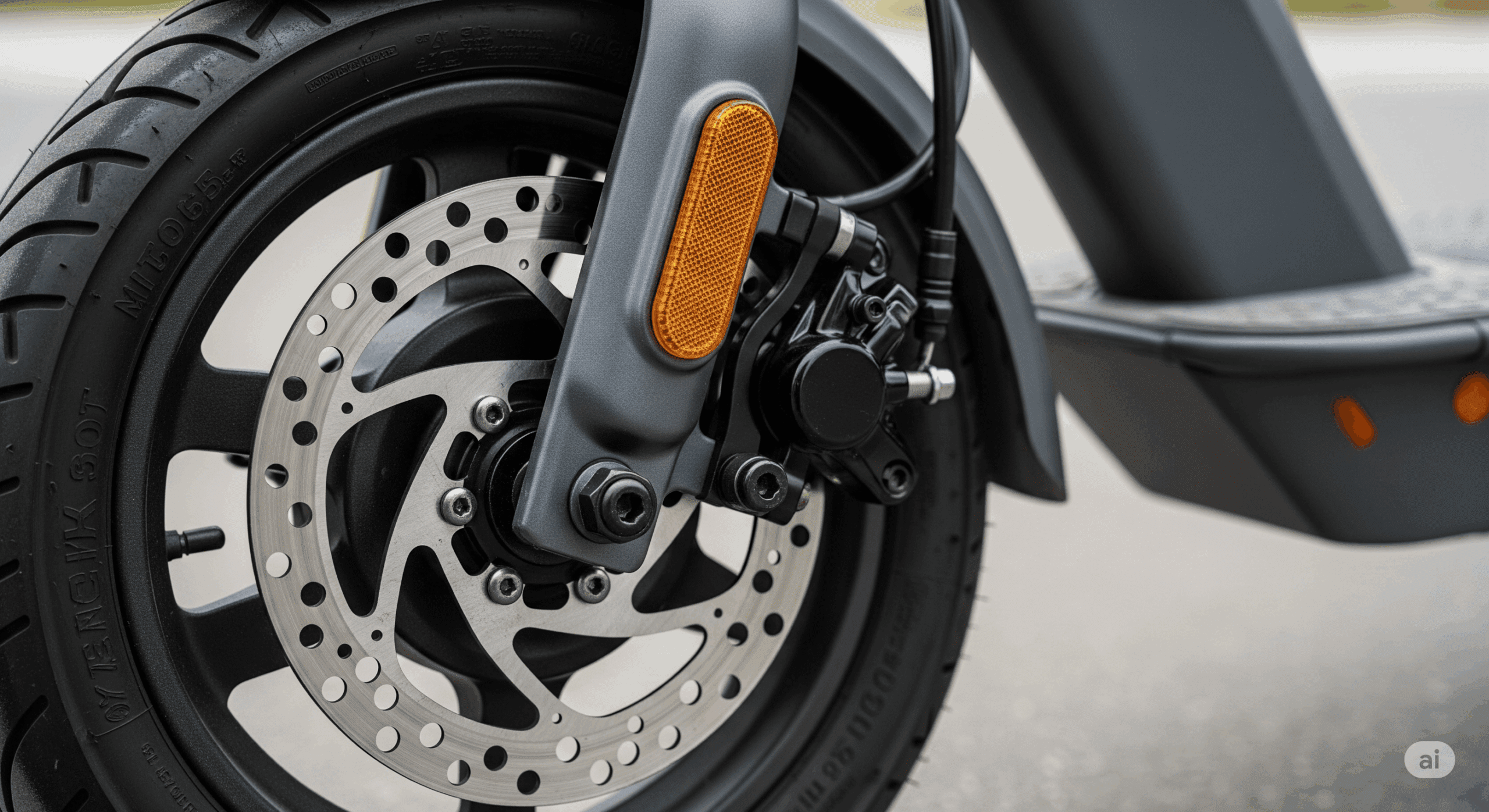
Being able to brake safely and effectively is crucial. In this guide we look at how brakes on an electric scooter work and why they are so important. You stand upright on a scooter, and even at relatively low speed a situation can become dangerous if you need to stop as quickly as possible.
Besides good brakes, however, the right technique is essential. Understanding what type of brakes your scooter has and how they work is absolutely crucial for your safety. When choosing a scooter, pay particular attention to the braking system. Does it have one or two braking systems? If possible, always choose a dual system – if one fails, you have a backup.
Correct braking technique: the foundation of safety
Before we dive into the technical details, it is important to master the right stance and braking technique.
- Never ride with your feet side by side! In this stance you are much less stable. Instead, stand like on a snowboard – one foot in front, the other behind.
- When braking, bend your knees, straighten your arms slightly and lean back. This keeps the scooter balanced, shifts your centre of gravity backwards and stops you from going over the handlebars.
Types of braking systems: one or two?
Some scooters have a brake on only one wheel (front or rear). Such a system will never brake as effectively as a dual braking system, where both wheels brake. The difference is even more pronounced on wet roads, where grip is lower.
- Front brakes provide more braking force because, during braking, the centre of gravity shifts forward and loads the front wheel more. On powerful electric scooters, however, be careful – using a strong front brake too abruptly can be dangerous.
Mechanical vs. electronic brakes
Scooter braking systems fall into two main categories: mechanical and electronic (e-brakes). Mechanical brakes include disc, drum and foot brakes. Electronic brakes include regenerative and purely electronic brakes.
You should regard electronic and regenerative brakes as a supplement and never rely on them as your main braking system.
Overview of brake types
Disc brakes
Disc brakes are considered the most powerful and are used today on almost anything with wheels.
- How do they work? Squeezing the brake lever presses the brake pads onto a rotating disc attached to the wheel, creating friction that slows the vehicle.
- Types of disc brakes:
- Hydraulic: Pressure is transmitted by hydraulic fluid in a closed system. They offer the best braking performance and phenomenal control.
- Semi-hydraulic: A combination of a cable from the lever and a hydraulic caliper at the wheel. A good compromise between power and low maintenance.
- Mechanical (cable): The most common type on scooters. Force is transmitted by a cable. They are effective, reliable, relatively cheap and easy to maintain and adjust.
- Advantages: Excellent braking power in the dry and wet, light, good cooling, easy maintenance and replacement.
- Disadvantages: More expensive than drum brakes, can be noisy (squealing) if the disc or pads get contaminated.
Drum brakes
Although they sound "old-fashioned", they are quite effective and need minimal maintenance.
- How do they work? The system is enclosed in the wheel hub. The brake shoes are pushed outwards against the inside of the rotating drum, creating friction.
- Advantages: Low maintenance, good performance in wet conditions (the system is protected from the elements).
- Disadvantages: Weaker than disc brakes, quickly lose effectiveness when they overheat, heavier and more complicated to service.
Foot brakes
The simplest type of brake, common on cheap and children's scooters.
- How do they work? By pressing the rear mudguard with your foot you push it against the tyre, slowing it down.
- Advantages: No maintenance, very light.
- Disadvantages: Weak braking performance, especially in the wet. They require an awkward body position when braking. They should be regarded more as an emergency brake.
Regenerative brakes
This system is also known as KERS from motorsport.
- How do they work? Instead of creating friction, the motor electronically switches into charging mode, creating resistance and slowing the scooter. At the same time it recovers a small amount of energy back into the battery. It is activated either by releasing the throttle, squeezing the brake lever or pressing a special button.
- Advantages: No maintenance, light, slight energy recovery.
- Disadvantages: Weak braking performance. May not work when the battery is fully charged.
Electronic brakes
They work on a similar principle to regenerative brakes, but don't recover energy. They simply create resistance in the motor by short-circuiting it.
- Advantages: No maintenance, light.
- Disadvantages: Weak braking performance; some simple systems can fail.
Final summary
Currently, mechanical brakes are far better than electronic ones. And among mechanical brakes the winner is disc brakes – they are powerful, reliable and easy to maintain. Electronic brakes are a useful supplement, but should never be the only braking system.
Check your brakes regularly. Before every ride, gently squeeze them at low speed to make sure they work. If you have disc brakes, keep an eye on pad wear. If you've just bought a new scooter, find a safe place and practise braking from a higher speed so you know your braking distance and how strongly your brakes bite. Knowing your brakes is the basis of safe riding.