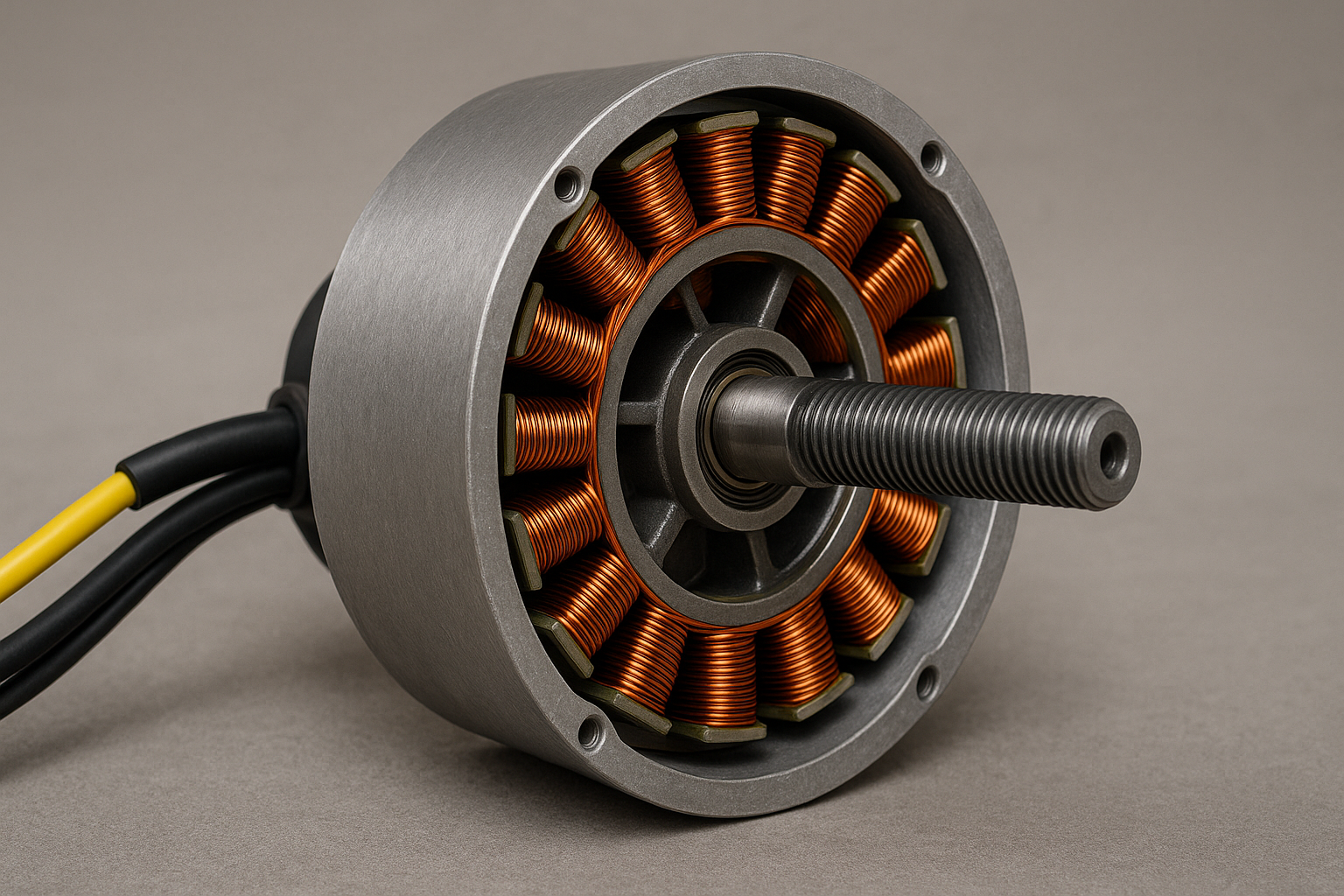
A detailed technical description focusing on how the motor turns
The basics of electromagnetism
An electric motor is a device that converts electrical energy into mechanical energy (rotational motion). It relies on a basic physical phenomenon:
An electric current flowing through a coil creates a magnetic field.
The interaction of magnetic fields causes motion.
This principle is the basis of all electric motors – including those in electric scooters.
Parts of an electric motor
A typical BLDC (brushless DC) motor, the type most commonly used in scooters, consists of two main parts:
1. The stator (the stationary part)
- It contains copper windings (coils) that are energised alternately.
- These windings are arranged into so-called phases – usually 3 (a three-phase motor).
2. The rotor (the rotating part)
- It is located inside or around the stator (depending on the design).
- It contains permanent magnets that react to the magnetic field created by the stator.
- When the magnetic field changes, the rotor tries to keep its orientation and turns.
How rotation is achieved – step by step
Step 1: energising the coils (stator)
The controller sends current to one or more coils in the stator in a specific sequence. This creates a magnetic field that "pulls" the rotor into a new position.
Step 2: sensing the rotor position – Hall sensors
For the controller to know which winding to activate next, it needs to know the current position of the rotor.
For this purpose motors use Hall sensors (named after the physicist Edwin Hall).
What is a Hall sensor?
A Hall sensor is a small electronic component that detects the presence of a magnetic field. When a rotor magnet approaches the sensor, it generates a signal that tells the controller where the rotor is.
How does it work?
- A motor typically has 3 Hall sensors evenly spaced near the coils.
- The sensors detect the passing of the rotor magnets (north – south) and generate pulses.
- The controller tracks these pulses and can time the next step of the rotation precisely.
Advantages of Hall sensors:
- They allow a smooth start from standstill
- They increase the efficiency and precision of rotation
- They prevent stuttering or jerking
Without these sensors the motor couldn't work reliably at low speeds. Some cheaper or high-performance motors also work without sensors (so-called sensorless mode), but they start less smoothly.
Step 3: switching phases (commutation)
Based on the outputs of the Hall sensors, the controller cyclically changes which windings (phases) are energised – this is called electronic commutation. This creates a rotating magnetic field that "pulls" the rotor along with it.
Imagine it as a series of magnets that switch on and off one after another – the one nearest the rotor always "attracts" the rotor magnets, so the rotor keeps turning.
Step 4: continuing the motion
The rotor tries to constantly follow the rotating magnetic field created by the stator. This cycle repeats several thousand times per second. The result is a smooth rotation of the wheel.
Example of a 3-phase BLDC motor
The motor has windings for 3 phases: A, B and C.
Commutation takes place, for example, in this order:
| Step | Phase A | Phase B | Phase C |
|---|---|---|---|
| 1 | +V | -V | 0 |
| 2 | 0 | -V | +V |
| 3 | -V | 0 | +V |
| 4 | -V | +V | 0 |
| 5 | 0 | +V | -V |
| 6 | +V | 0 | -V |
Each step means a new "setting" of the magnetic field, which moves the rotor by a certain angle.
How is speed controlled?
The motor speed is controlled by:
- The number of commutation steps per second – the more steps, the faster the motion.
- The voltage and current supplied to the coils – higher voltage = higher rpm; higher current = more torque.
What does "brushless" mean?
A brushless motor (BLDC) uses electronic commutation rather than mechanical (no brushes or commutator). This brings advantages:
- Less wear
- Quieter operation
- Higher efficiency
- Less overheating
How is the motor cooled?
Under load the motor heats up. Cooling can be:
- Passive – through metal parts, usually aluminium.
- Active – a fan or heat pipes on high-performance scooters.
- Temperature sensors – if it overheats, the controller reduces power or shuts the motor down.
Summary: how does an electric motor turn?
Current through the coils creates a magnetic field → the magnetic field attracts the rotor magnets → Hall sensors report the position → the controller commutates the phases accordingly → the rotor turns smoothly.
A new chapter: regenerative braking – the technical principle
What is regenerative braking?
Regenerative braking is a technique in which the kinetic energy of the moving vehicle is converted back into electrical energy during braking and stored in the battery.
Instead of the energy being lost as heat during braking (as with a mechanical brake), the motor temporarily becomes a generator.
⚙️ How it works – step by step
▶️ 1. The braking command
The rider presses the brake lever or the electronic brake is activated (e.g. a thumb lever).
The system decides whether to activate regenerative braking (the so-called electrodynamic brake), the conventional mechanical brakes, or a combination.
▶️ 2. Changing the motor mode
The controller changes how the motor windings are powered – instead of supplying current to the motor, it allows the spinning rotor to generate a reverse current in the windings.
In other words: the motor becomes a generator – the rotor keeps turning (because of the scooter's inertia), and this induces a voltage in the stator windings.
This phenomenon is called back EMF (back electromotive force). It is the voltage generated by the motor when it turns without being powered – the higher the rpm, the higher the back EMF.
▶️ 3. Generating reverse current (back EMF)
The current from this voltage is then:
- rectified through diodes or transistors in the controller (bridge)
- and, via a DC-DC converter, returned to the battery
▶️ 4. Charging the battery
The battery receives part of the generated current as charging current. The controller makes sure that:
- the current isn't too high (battery protection)
- the voltage doesn't exceed the maximum
- it only activates at a sufficiently high speed (low back EMF is inefficient)
⚠️ Technical limitations of regenerative braking
| Limitation | Explanation |
| ⚡ No regeneration at low speed | Back EMF is directly proportional to motor rpm – if the scooter is moving slowly, the generated voltage is too low. |
| 🔋 The battery must be able to accept current | When the battery is fully charged or in winter, regeneration may be disabled to protect the cells. |
| 🛑 It is not a replacement for mechanical brakes | Regeneration has limited braking force. Emergency or hard braking requires conventional (disc) brakes. |
| 🧠 More complex controller electronics | It requires a sophisticated algorithm that regulates the reverse current into the battery. |
Efficiency of regenerative braking
- The typical real-world efficiency is 5–20% (of the total energy that would otherwise be lost).
- It brings the most benefit on long descents, frequent city riding and for riders who brake often.
- The main benefits are extended range and less wear on the mechanical brakes.
Summary: regenerative braking
During braking the electric motor turns into a generator. The energy of motion is converted into electric current which (if conditions allow) is stored back in the battery.
The process is controlled by the controller and depends on the rpm, the battery's state and the system's limits. It doesn't completely replace mechanical brakes, but it helps to extend range and save components.