Every cyclist knows the feeling. You get back on your bike after a long break, the first gentle climb comes and you're gasping for breath, feeling as if your lungs are about to burst out of your chest. Building cycling fitness doesn't happen in a weekend, but if you approach it systematically, your body can adapt surprisingly quickly.
The biggest mistake beginners make is riding "flat out or not at all". The result is quick burnout, overtraining and a loss of motivation. Real fitness is built slowly and sensibly.
The basic pillars of cycling training
Before you start following a plan, you need to understand three basic rules on which every successful training programme is built.
- Consistency beats intensity: It's much better to ride three times a week for an hour than to go on one exhausting four-hour ride once a week. The body needs regular, repeated stimuli.
- The magic of Zone 2 (the endurance zone): Roughly 80% of your training time should be at low intensity. It's a pace at which you can talk in full sentences while pedalling without getting out of breath. This "slow" riding builds capillaries in your muscles, teaches your body to burn fat instead of sugar and builds the all-important aerobic base.
- Recovery is part of training: Fitness doesn't grow while you're pedalling, but when you rest after training. Your muscles need to repair and get stronger. Skipping rest days leads to stagnation.
How to progress: three phases to better fitness
Your training should develop gradually. You can't start with intervals straight away, or you'll get injured.
1. Base-building phase (weeks 1–4)
Forget speed and average kilometres per hour. Your only goal is to get your backside used to the saddle and your muscles used to pedalling. Ride only on the flat or on gently rolling terrain. Stick strictly to a conversational pace (Zone 2). If you hit a hill and start gasping for breath, feel free to shift to the easiest gear or even get off. The goal is volume, not pain.
2. Strength and tempo phase (weeks 5–8)
Your aerobic base is now more solid. Start adding one more intense day to your training. Add "sweet spot" intervals – a pace that is already demanding and makes you breathe deeply, but that you could hold for 20 to 30 minutes. In this phase, start deliberately seeking out shorter hills.
3. Specific performance phase (weeks 9–12)
Now you're ready for real intervals. Devote one day a week to short, intense sprints (for example 1 minute flat out, 2 minutes easy), which will rapidly increase your explosiveness and maximum oxygen uptake (VO2 max). Gradually lengthen your weekend rides.
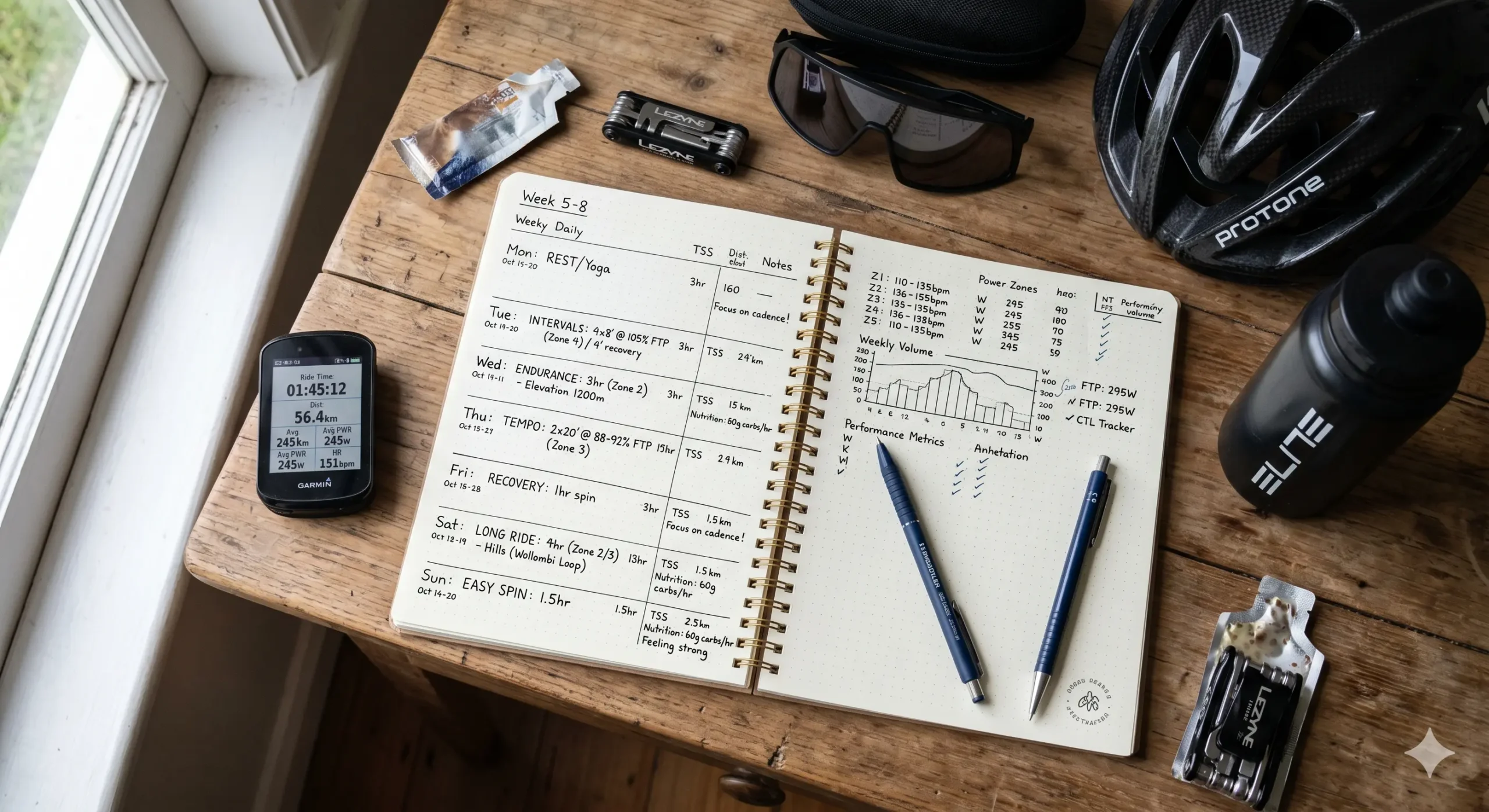
A sample weekly training plan (for phases 2 and 3)
This plan is designed for an ordinary working person who has limited time during the week but can enjoy a longer ride at the weekend.
| Day | Type of training | Duration | Description and goal |
| Monday | Complete rest | 0 min | No bike. Time for stretching, foam rolling or a gentle walk. |
| Tuesday | Intervals / hills | 60 min | 15 min warm-up. Then 5× (3 minutes at a hard pace uphill / 3 minutes descent or easy). 15 min cool-down at the end. |
| Wednesday | Active recovery | 45 min | A completely easy spin on the flat. The pace must be so slow that it feels as if you're not training at all. |
| Thursday | Tempo ride | 60–90 min | A steady, brisker ride. 2× 15 minutes at a pace where you sweat and breathe harder, but don't get completely out of breath. |
| Friday | Complete rest | 0 min | Getting your body ready for the long weekend ride. |
| Saturday | LSD (long slow distance) | 2–4 h | The main endurance builder. A strictly conversational pace (Zone 2). Take plenty of food and drink. |
| Sunday | Free ride / family | 1–2 h | Riding for fun. To a café, with the family or just without watching the numbers. |
4 tips to maximise your results
- Cadence is king: Try to spin at a high cadence, ideally around 85 to 95 revolutions per minute. Grinding heavy gears at 60 rpm is extremely hard on your knees and quickly depletes glycogen in your muscles.
- Don't ride on an empty stomach: Long rides need fuel. Before a ride, eat a carbohydrate meal (porridge, a banana), and on rides longer than 90 minutes eat at least 30–50 grams of carbohydrates every hour (a banana, an energy bar).
- Drink before you're thirsty: Losing even 2% of your body fluids means a drastic drop in performance. Take small sips every 15 minutes, ideally an isotonic drink rather than plain water.
- Track your progress (but don't obsess over it): Download an app such as Strava or keep a diary. Seeing that you can now climb the same hill two minutes faster and with a lower heart rate than a month ago is the best motivation to keep going.