How the Electronic Brake on Electric Scooters Works – A Detailed Technical Look
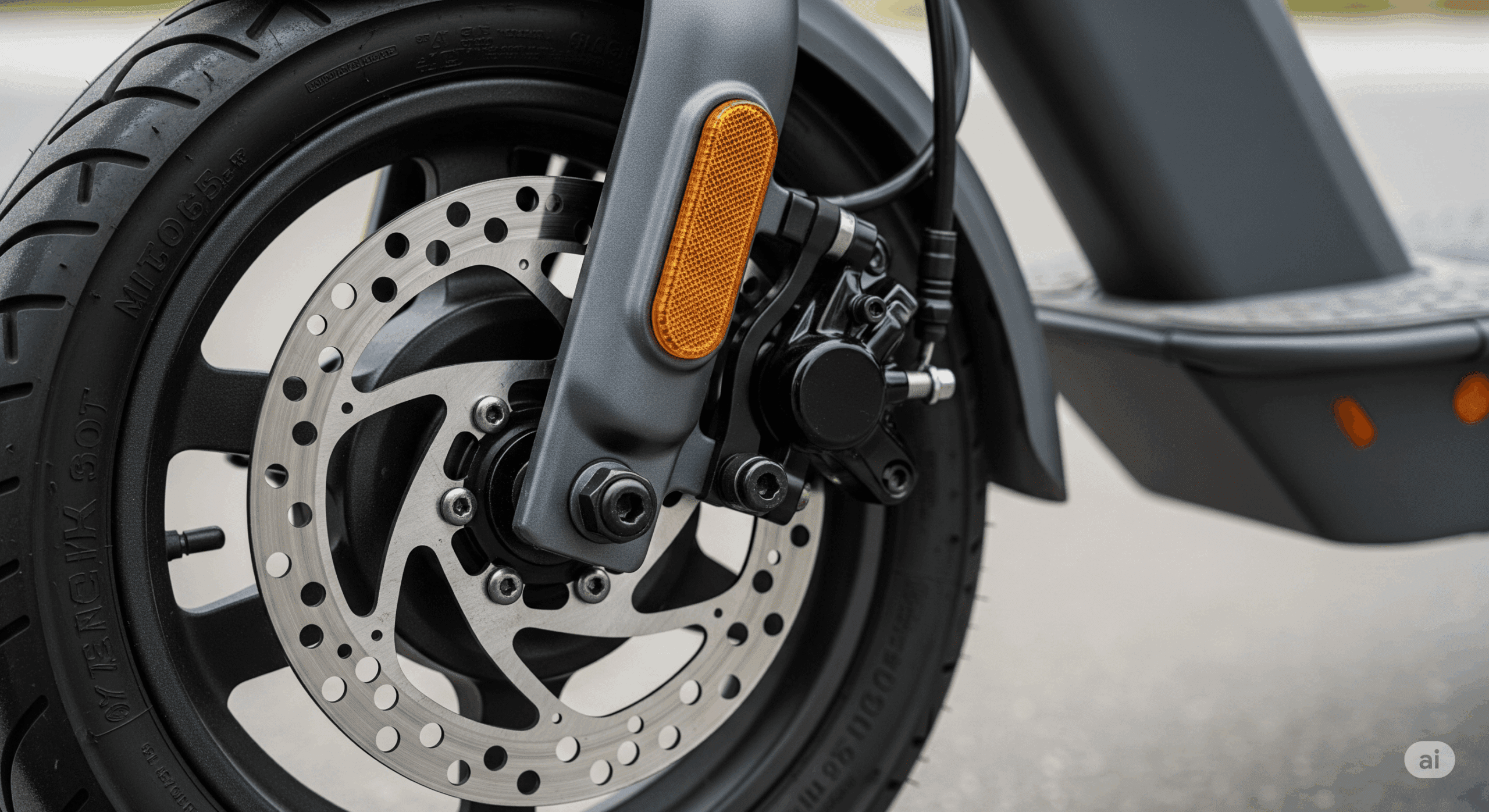
The electronic brake is an important part of a modern electric scooter. It allows effective deceleration without mechanical components and in some cases can even return energy to the battery. But how does it work from a technical point of view?
In this article we'll look at the operating principle, how it is triggered, the types of sensors, the options for setting its intensity, and the advantages and limits of this technology.
Types of electronic brakes
- Regenerative brake (regen braking)
The motor works as a generator and converts kinetic energy back into electrical energy, which is then stored in the battery. - Resistive electronic brake
The energy from the motor is not fed back but converted into heat in the windings or a load. It is used where regeneration isn't possible (e.g. when the battery is full). - Combined braking
Many scooters combine electronic braking with mechanical brakes (disc, drum or foot brake) for greater safety and reliability.
Technical principle of operation
Controlled braking torque
The electronic brake works on the principle of back electromotive force (back EMF). During braking, the electric motor switches from drive mode to generator mode:
- the rotor keeps turning thanks to the inertia of the wheels
- a voltage is induced in the stator windings
- the energy is directed either to the battery (regeneration) or to a braking resistor (resistive braking)
The ESC (electronic speed controller) controls in real time:
- the braking intensity
- the transition from riding to braking
- the direction of energy flow
How is the electronic brake triggered?
1. Automatic deceleration when releasing the throttle
Some scooters apply light braking even without using the lever as soon as the rider releases the throttle. This is a so-called passive electronic brake, which helps to stabilise speed.
2. Activation via the brake lever
More commonly, braking is triggered by the brake lever, which sends a signal to the ESC. There are two basic types of lever:
Brake lever with a micro-switch (digital switching)
- Contains a simple NO micro-switch (normally open)
- When pressed, the contact closes and sends a digital ON/OFF signal to the ESC
- The ESC then applies the brake at a fixed intensity
Advantage: a simple and reliable solution
Disadvantage: the braking force can't be controlled
Brake lever with a Hall sensor (analogue control)
- Measures the lever position using a magnetic field
- Produces an analogue signal (e.g. 0.8–3.3 V)
- The ESC controls the braking force according to the voltage – the harder you press, the harder it brakes
Advantage: smooth modulation
Disadvantage: slightly more complex electronics
Setting the electronic brake intensity
Many controllers allow you to set the strength of the electronic brake. Usually via:
- the menu on the scooter's display (e.g. P-settings)
- a mobile app over Bluetooth
- advanced ESC systems (e.g. VESC Tool)
Typical ranges:
- 0 to 5
- weak / medium / strong
- or as a percentage (e.g. 20–100%)
Some models also let you set the braking curve – e.g. a gentle onset and hard braking only when the lever is pressed firmly.
Caution: a brake that is too strong can cause a jolt or lock the wheel, especially if the front motor is doing the braking.
Regeneration and energy flowing back
With regenerative braking:
- the voltage generated by the motor must be higher than the battery voltage
- the ESC uses MOSFET transistors to direct current back into the battery
- if the battery is full, the system switches off regeneration or changes to resistive braking
Some scooters use braking resistors to dissipate excess energy as heat.
Advantages and limitations
Advantages:
- extended range (with regeneration)
- less wear on the mechanical brakes
- quiet operation and precise modulation
- programmability
Disadvantages and limitations:
- weak effect at low speeds
- doesn't work if the battery is full or damaged
- not a replacement for a mechanical brake
- requires a quality ESC and correct settings
Conclusion
The electronic brake is now a common but technically very interesting part of electric scooters. It works on electromagnetic principles and allows intelligent control of deceleration – either through regeneration or in resistive mode.
When configured correctly, it increases riding comfort, extends range and reduces component wear. For safety, however, it should always be combined with a mechanical braking system.