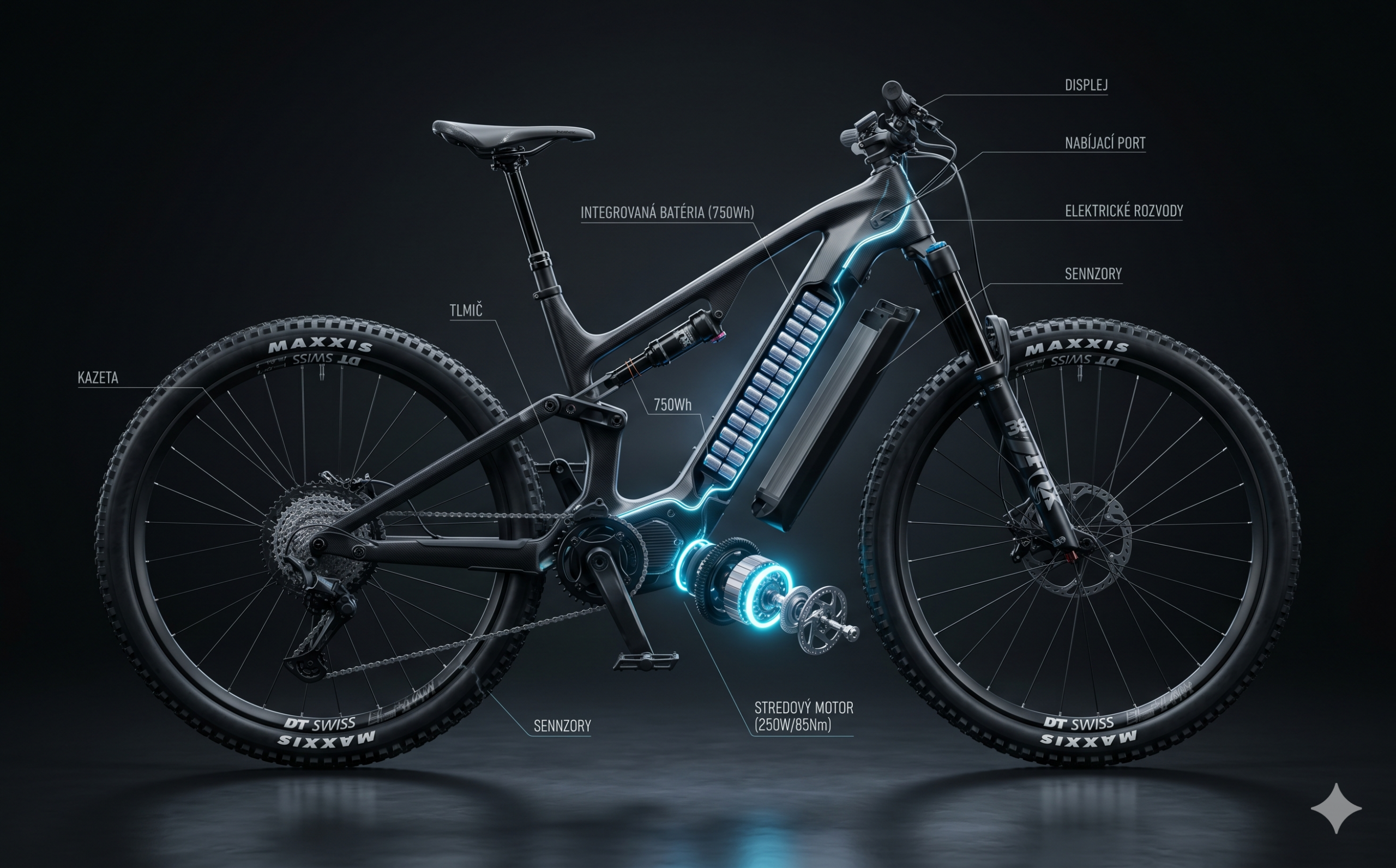
From the outside it may seem complicated, but the basic principle of an electric bike is actually beautifully simple. It isn't a motorbike where you just twist the throttle. A modern e-bike works on the principle of so-called assistance – the motor only helps you when you put in effort yourself. It's as if you constantly had a strong tailwind, or as if someone invisible were pushing you up the hill with a hand in the small of your back.
For this smooth miracle to work, several key components have to work together in perfect harmony.
The holy trinity of the e-bike: motor, battery and brain
An electric bike differs from a conventional one by having three main components that make up its drive system.
- Motor (the muscles): It generates the actual power. Today we most often see mid-drive motors (located at the bottom bracket, where the cranks and pedals are). These motors are ideal for off-road riding because they keep the centre of gravity low and transfer power directly to the chain, so they can make efficient use of the bike's gears. A cheaper alternative is hub motors in the rear or front wheel, better suited to city bikes.
- Battery (the fuel tank): It consists of many interconnected lithium-ion cells (similar to those in your smartphone, just on a larger scale). Capacity is given in watt-hours (Wh) – from 400 Wh on light e-bikes to 750 Wh and more on heavy-duty electric mountain bikes. It also contains a BMS (Battery Management System), a safeguard that protects the cells from over-discharge, overcharging and overheating.
- Control unit and display (the command centre): This small computer on the handlebars lets you choose the level of assistance (Eco, Trail, Turbo) and displays your speed, range and battery status. The control unit constantly communicates with the motor and decides how much energy to send from the battery to the motor based on your current needs.
Sensors: why an e-bike doesn't ride like a moped
This is the most important magic of modern e-bikes. How does the motor know exactly when to kick in and when to stop helping? It does this using two types of sensor.
- Cadence sensor (rotation sensor): This simpler sensor only registers whether and how fast you are pedalling. When you start pedalling, it sends a signal and the motor switches on the full assistance of the selected mode. There is a slight delay at the start and it feels a bit "on-off".
- Torque sensor (pedalling force sensor): This is the secret weapon of more expensive bikes and mid-drive motors. The sensor measures precisely how hard you are pushing on the pedals. If you're riding on the flat and just turning the pedals gently, the motor helps minimally. But as soon as you push hard on a climb, the sensor registers it instantly and the motor sends you a massive dose of power. The result is an absolutely natural riding feel – the bike simply multiplies your own strength.
Added value: pedelec vs. electric motorbike (what the law says)
You may be wondering why the motor doesn't help you on a descent when you're doing 40 km/h. It's because of European and Slovak legislation.
- Standard e-bike (pedelec): For your bike still to count as a bicycle under the law (so you don't need a driving licence, number plate or compulsory insurance), the motor may have a nominal output of at most 250 W and must switch off automatically at 25 km/h. Above this speed you're on your own. It also must not be able to ride without pedalling (no throttle).
- Speed pedelec (S-pedelec): These bikes assist up to 45 km/h. In Slovakia and most of the EU they are legally considered mopeds. You need a driving licence (AM), a moped helmet, a mirror, insurance and a number plate. You may not legally ride them on ordinary cycle paths.